

The design and printing of self-adhesive labels and products mainly includes anti-counterfeiting labels, barcode labels, electronic product labels, transparent PVC self-adhesive labels, matte silver labels, and health product labels.
New Methods for Small-Batch Self-Adhesive Label Printing
Currently, large-volume self-adhesive label printing primarily uses letterpress and flexographic printing. However, the market demand for personalized small-batch self-adhesive labels is increasing. Tens of thousands of small labels, bound together on A4 or A4 sheets, only amount to a few thousand or a few hundred copies. Roll-to-roll label printing machines become less cost-effective for such jobs.
From a product perspective, small-batch jobs require low cost and short delivery times; while product quality often demands vibrant colors and a layered layout composed primarily of halftone dots. In response, many small printing companies use A4 monochrome offset printing machines for four-color overprinting, achieving very good results. This combination offers several advantages for offset printing machines:
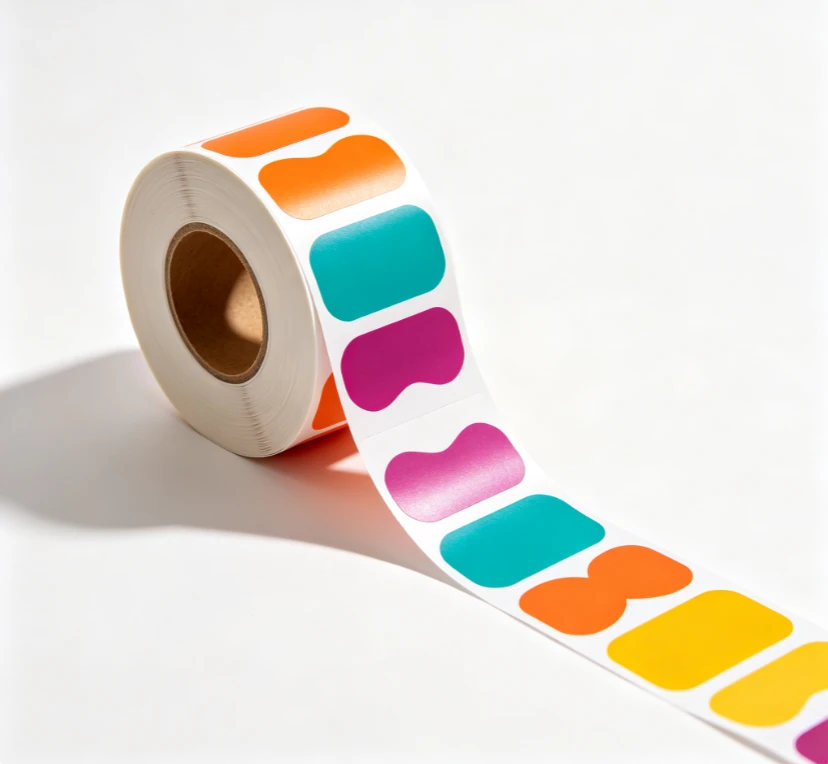
Reducing Printing Costs
Among offset, letterpress, and gravure printing, offset printing is the lowest-cost method. In prepress processes, compared to the complex plate-making process of flexographic printing, the production, film output, and exposure of PS plates are relatively simple for printing plants. Technically speaking, after phasing out letterpress printing, most printing plants have switched to offset printing, so there are no additional burdens.
If a roll-to-roll self-adhesive label printing press is used, there is a waste of over ten meters of paper upon startup. If the registration is not properly adjusted, the paper path of the unit-type printing press is long, resulting in significant waste. Offset printing presses, on the other hand, can use other types of paper as printing plates, saving on self-adhesive material.
Offset printing plates are much cheaper than letterpress and flexographic printing plates and require few auxiliary materials. The printing pressure can be easily adjusted when printing on paper of different thicknesses. Operationally, offset printing technicians are easy to hire, and the technical threshold is not high.
Printing plant experience has shown that the cost of printing small self-adhesive labels using offset printing presses can be reduced to a fraction of a cent. Even with profit margins calculated in cents or millimeters for processing supplied materials, profitability is still achievable.
Ensuring Printing Quality
Unlike self-adhesive labels from countries like Japan, Chinese self-adhesive labels are mostly multi-layered graphic jobs, especially small-batch labels, requiring vibrant colors. Offset printing has advantages in halftone printing. On-site printing is also excellent. If increased ink thickness is needed, the advantage of accurate registration can be utilized for secondary printing. Due to the small-batch nature of printing, time is not a concern.
Furthermore, using fast-drying offset inks, adding drying agents to the ink, and spraying powder after printing can effectively solve the problem of print smudging and improve work speed.
Shortening Printing Cycles
Short-run printing emphasizes timeliness. Offset printing has a short plate-making cycle, making it a suitable choice for short-run label printing with complex designs and high time sensitivity.
Printing self-adhesive materials using offset printing machines also presents certain challenges, mainly twofold:
In the market, self-adhesive materials are currently mostly sold in rolls. Printing with a sheet-fed offset printing machine requires cutting the material into sheets. If the printing plant re-cuts the labels themselves, it's time-consuming and labor-intensive; assistance from the self-adhesive material supplier is necessary in this regard. Furthermore, freshly cut self-adhesive sheets are curled and require flattening. After a considerable period of pressing, they also need to be patted before printing.
Offset printing machines do not include die-cutting units. The printed self-adhesive sheets are not finished products and must undergo post-printing processing using a die-cutting machine to create oval, triangular, and other irregularly shaped labels, adding an extra step to the process.
Based on experience, printing equipment should be used according to the needs of the product being printed; choose the appropriate equipment for the specific product.